

Wulf D. von Lucius
In the world of rare books, the reappearance of a significant collection on the market is always a notable event. A collection carefully assembled over decades with connoisseurship and dedication returns to the world of collectors from which it first emerged. A finely wrought whole, patiently built from individual works, is dispersed so that it may be re-formed in new and meaningful ways in the hands of future custodians.
This bibliophile cycle can be likened to a tree whose leaves fall in autumn, allowing fresh growth to emerge in spring. Within this process of organic decline and renewal, melancholy and quiet expectation sit side by side. Yet what distinguishes the world of books from natural processes is the possibility of an enduring record, a kind of memorial stele, realised in carefully produced auction catalogues, such as the present volumes dedicated to the artist books collection of Dr Rolf Renker, who passed away last year at the age of 98.
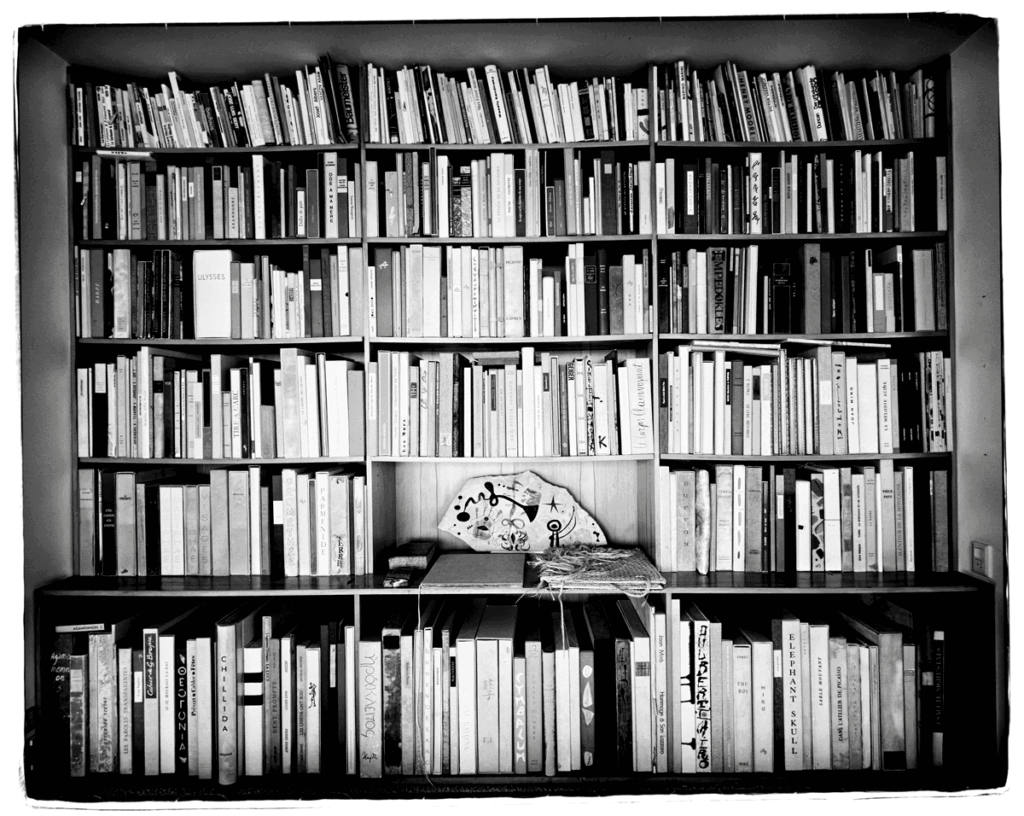
Renker’s collection enjoyed an almost legendary reputation among collectors, not least because few had ever seen it. Housed in distant New Zealand, where he had settled in the 1980s, it was known to most only through the accounts of the privileged few who had been able to visit. This geographical remoteness was compounded by Rolf Renker’s own reserve. He neither sought the limelight nor courted attention but consciously avoided both. He organised no exhibitions of his holdings, published nothing himself, and did not, as many collectors are inclined to do, adopt a bookplate. Above all, the collection was a deeply personal source of inspiration and pleasure.
The seriousness with which he pursued the artist’s books is evident in the scope and structure of the collection. It encompasses early examples from the late nineteenth century, including Édouard Manet’s etchings for Le Fleuve (1874), as well as many of the major works of the twentieth century, among them Pierre Bonnard’s Parallèlement (1900), Max Ernst’s Maximiliana (1964), and Henri Matisse’s Jazz (1947). Alongside these are artist’s books from the twentieth and twenty-first centuries, selected with equal care and discernment. These include numerous works from Kaldewey Press (often in special editions) produced between 1988 and 2013 as well as books by Herbert Dirnaichner and Veronika Schäpers, among others.
The Renker collection can be regarded as a living encyclopaedia of twentieth-century book art, extending both to its precursors and its later developments. It includes substantial holdings of books by Pablo Picasso (42) and Joan Miró (54). Almost uniquely, the collector succeeded in bringing together 15 of the 19 artists‘ books published by Iliazd (Ilya Zdanevič) under the imprint 41°. The École de Paris is almost entirely represented, and the collection also encompasses the work of later generations, including the major American artists Helen Frankenthaler and Joan Mitchell, as well as Robert Motherwell and Richard Tuttle.
Rolf Renker was a collector of broad and discerning taste, embracing both canonical works of the past and innovative developments in contemporary book art. Although he owned many special editions, he was not a trophy collector; rather, he sought to represent the full breadth of artist’s books. In this respect, he stood within a longstanding family tradition of papermaking that had already produced several notable collectors before him.
It should also be noted that alongside artists’ books, Renker built an extensive collection of eighteenth-century books and travel literature. He possessed a genuine collector’s instinct. My wife and I experienced his curiosity about the unknown first hand when he visited us in Stuttgart. He politely waved aside the French artists’ books as well as many contemporary examples — he already knew and owned them, after all. What interested him were artists and books not (yet) represented in his collection, and it was these that shaped our conversation over dinner. As the evening progressed, the characteristically reserved Rolf Renker gradually warmed to us, and the ILAB motto once again proved apt: amor librorum nos unit.
Collectors worldwide are now invited to acquire works from Rolf Renker’s magnificent collection, their exceptional provenance lending them a particular distinction. The series will continue with two further auctions presenting further works from the collection.
(Translated by D. R.)