Ausrufzeit : ca. 16:44 Uhr (ohne Gewähr)
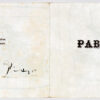
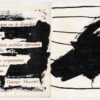
Eins von nur sechs Vorzugsexemplaren auf Japon nacré. – Gedruckt im Auftrag des Verfassers bei Grou-Radenez, Paris. – Druckvermerk vom Verfasser signiert und nummeriert und vom Künstler signiert. – Auf der Titelseite mit eigenhändiger Widmung des Verfassers »pour Yvonne Zervos son ami«, signiert und datiert 31.1.1941. Yvonne und Christian Zervos leiteten ab 1934 eine Galerie und verfassten das bis heute maßgebliche Verzeichnis der Handzeichnungen Picassos. – Hugnets Text, der bereits im Januar 1940 entstanden war, wurde in braun in die Randzeichnungen Picassos eingedruckt. – In Schmuckschatulle. – Die kleine klandestine Hommage für seinen Künstlerfreund Picasso erschien während der deutschen Besatzung Frankreichs. Es folgten weitere ähnlich gestaltete Ausgaben illustriert von Valentine Hugo bzw. Marcel Duchamp, die wahrscheinlich als Geschenk unter der Hand verteilt wurden. – »The majority of these pamphlets seem to have been distributed clandestinely among the poet’s friends and associates as a form of defiance to the German Occupation.« (R. F. Johnson, in: Logan Collection 2001).
Goeppert/Cramer 35. – Nicht bei Bloch. – LC 2001 115. – Nicht bei Monod
9,7 : 15,0 cm. [8] Seiten. – Ganz leicht gebräunt.
english description:
In January, 1940, Georges Hugnet wrote a poem entitled „Pablo Picasso“, in which he incited the entire universe to waltz unrestrainedly. At this time, Picasso was living in Royan, but he would return to Paris from time to time to visit with friends like the Zervos‘, Brassaï, Man Ray, and Hugnet, who had not been drafted into the armed forces.
In August 1940, after German troops had entered Royan, Picasso returned to Paris to live. In the meantime, Hugnet had joined the Resistance, and made significant contributions toits cause by storing and distributing much-needed materials. In 1940, Hugnet published his poem Non vouloir with a reproduction of a drawing by Miró (see No. 36) in an 8-page, oblong pamphlet. In 1941, three pamphlets appeared: the present one, Pablo Picasso, as well as Aux Dépens des Mots, with a reproduction of a drawing by Valentine Hugo, and Marcel Duchamp, with a reproduction of a drawing by Duchamp. Judging by the number of dedicated copies, these pamphlets seem to have been distri-buted clandestinely among friends.
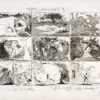
For the poem which bears his name, Picasso made wash illuminations, the plates of which were reworked with engraving by the artist. The more noteworthy of these are the three women’s heads, which remind one of the Royan notebooks (cf. Z. X, XI), and the ample body of a woman which enfolds Hugnet’s surrealist text, the expressive automatism of which recalls Picasso’s own poetry: „Cors crocs socs à corps et à cris / les palissades découvrent leurs corps crevés / (…) / ors rocs sorts trots valsez“.
Slightly browned.









![73 Pablo Picasso – Ramón Reventós. Deux Contes. 1947 [1948]](https://hesse-auktionen.de/wp-content/uploads/2026/05/424-1-320x412.jpg)
